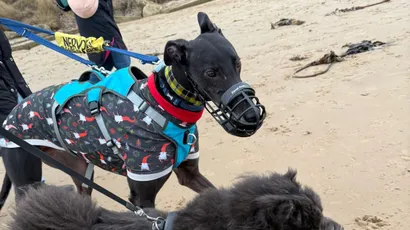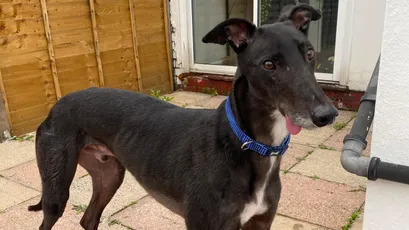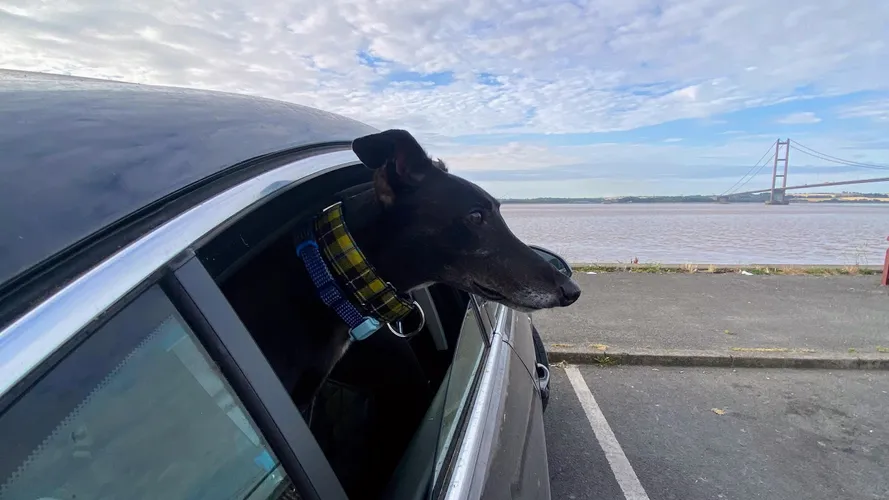
How to travel with your greyhound in the car
- Ross
- Training Tips , Settling In
- 30 Aug, 2026
TL;DR
Most greyhounds, particularly ex-racers, settle into car travel fairly easily thanks to their racing days spent travelling by van. A few treats or a short run-up can help encourage them to jump in, and if they need a hand, there are safe ways to lift them. Once in the car:
- A hammock with a solid base works well on the back seat, while a crate or blanket suits a larger boot
- Always strap your greyhound in using a harness clip or crate tether to keep them safe
- Short journeys, light meals and good airflow can help ease travel sickness
- A soft mat and high-value treats make it easier to coax them back out again
Are greyhounds good in the car?
Generally, greyhounds, particularly ex-racing greyhounds, are very comfortable when being transported by car. In their racing careers they will often travel by van to the race track in a crate, this makes them more comfortable with the swaying of a car and they can typically settle quite quickly when travelling.
It might take some time for them to fully get used to a car as opposed to a van though, which is what we have experienced. Winston is really confident when jumping into a van, and often will gravitate towards open van doors on walks due to his training in his past life. After a year, he now knows what the car is used for and is getting much more confident in hopping in. He would probably still love us to have a van instead though.
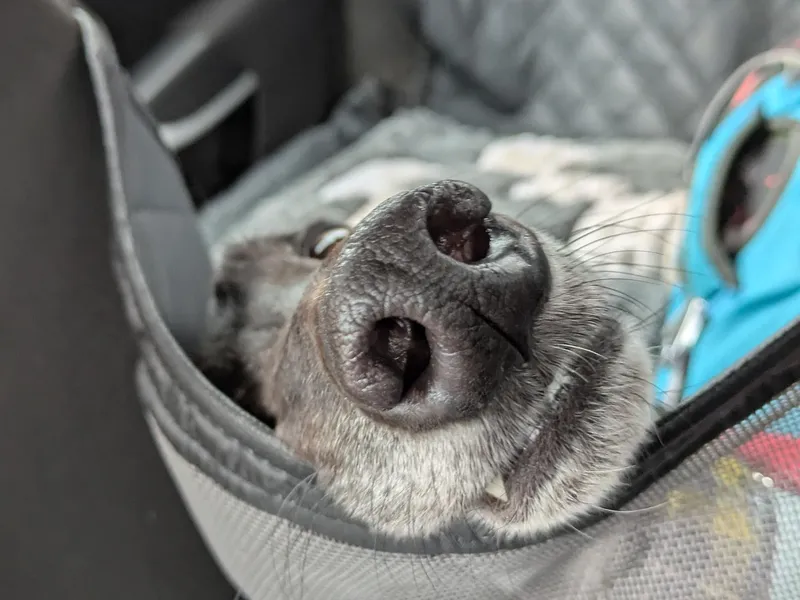
How to get your greyhound in the car
Having your greyhound jump into the car might sound like a simple task, and for some it is, but others might need a little extra encouragement.
Some tips for encouraging your greyhound to jump in the car which have worked for us:
- Throwing a treat far into the vehicle so they need to hop in to get it sometimes works, unless Winston is feeling particularly lazy
- Having a breadcrumb trail of treats from the outside of the car, leading them into the vehicle
- Taking a little run up to the open car door sometimes gives Winston the confidence and momentum he needs to make the leap without issue
How to pick up your greyhound
Picking up your greyhound can be a daunting prospect, especially if you have one a little on the larger side like we do. There are two situations which might mean that you need to give your greyhound a little extra help when getting into the car: they can only get their front paws in or they can’t/don’t want to try at all.
When you open your car door, they may hop their front legs inside the vehicle, but the idea of jumping up completely is a little much. This leaves them in an awkward spot. Luckily though, this is the easiest situation for you to help out. Here’s what you need to do:
Option 1: Lifting the back legs in
- Scoop one arm underneath their belly to give them support
- Using your other arm, scoop their back legs in so that their bum is resting on your forearm
- From here, lifting with your legs, you can raise their rear end to be level with the vehicle
- Slowly encourage them to walk their front legs forward until you can comfortably place them down with their hind legs in the car
Option 2: The full greyhound lift
- Using one arm, thread this through their front legs so that your palm meets their belly, allowing you to support their spine through the lifting
- Using your free arm, scoop their back legs in so that their bum is resting on your forearm
- Using your legs, lift your greyhound up until you have a straight back
- To put them back down, simply reverse these steps
The first few times you try this, it might be a bit stressful, I know it was for me. It does get easier though I promise. The longer you have your greyhound and the more trust you can build, the easier this will be. Winston was often quite dramatic after being lifted and taken somewhere, but he is now used to it and doesn’t make such a fuss.
Should you have your greyhound in the boot or the back seat?
Whether your greyhound travels in the back seat or the boot really depends on the type of car you have.
Travelling on the back seat
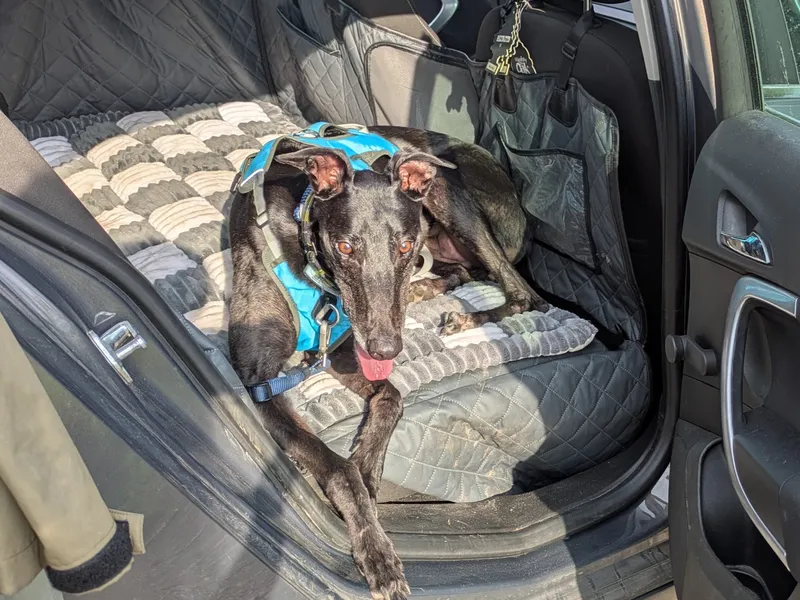
Our saloon car had a pretty spacious boot, but the shape would make it difficult for our tall greyhound to stand during travels. Therefore we need to have him on the back seat, of which he can easily take up the full thing. I imagine that this would also be the case if you had a hatchback or a mini-SUV.
When travelling on the back seat, there are some things you can do to make your greyhound more comfortable. We have a large hammock which connects the back seat headrests to the front seat headrests. This is fantastic since it removes the risk of your greyhound falling into the footwell when in transit which can happen due to sudden braking or the general clumsiness of the breed.
If you’re looking into getting a hammock, I’d recommend one with a solid bottom to prevent it from sagging into the footwell. We initially had one without this extra support and found Winston was quite uncomfortable in it.
It is also possible just to lay a blanket down on the backseat for your dog, but this does carry more risk and isn’t a way we have ever transported Winston.
Travelling in the boot
If you were to have a suitable vehicle, like a 4x4, van or an estate car, having your greyhound travel in the boot is a much more viable option.
Having a large boot means that you can often leave a blanket down and your greyhound will be more than happy. When out with other greyhound owners I have seen two, sometimes three, greyhounds emerge from a particularly spacious estate car. They seem to like this set up and it resembles their natural habitat, a padded space, likely a bed or sofa.
There is also the option to have a crate in the boot of your car or van. The main things to make sure you have considered here are that you have a crate large enough for your greyhound to stay comfortable, all hard edges have been cushioned to protect the fragile limbs of your greyhound, and that there will be enough ventilation in the crate particularly as cars can get quite hot and stuffy in summer months.
How to keep your greyhound safe in the car
When travelling in the car with your greyhound, there is no greater priority than safety.
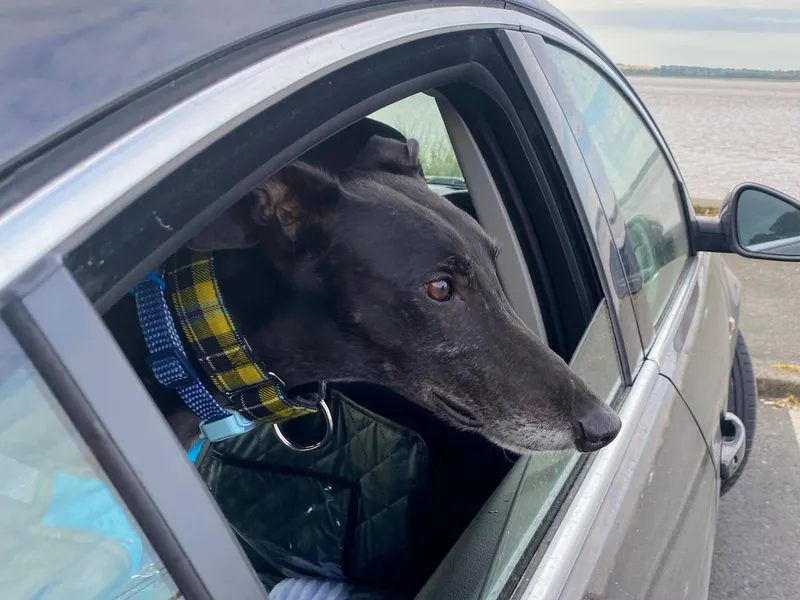
The first thing you should ensure is that you have your greyhound strapped in - we do this using a buckle which connects Winston’s harness into one of the seatbelt holders. This has two main benefits: it allows for Winston to remain stable over bumpy terrain and frequent stops, but it also keeps his snout out of the front part of the car which can be dangerous when driving. He still has plenty of slack to stick his head through a little bit, but without being strapped in, I don’t think he would hesitate too much to fully jump onto the passenger seat, especially when he sees the rabbits down a country lane.
Some people recommend tethers that go around the seat headrest as opposed to clipping into the seatbelt buckle, as some dogs find this more uncomfortable and have more freedom of movement. We haven’t personally tried these but worth noting as an alternative.
If you have your dog in a crate when travelling instead, there are also safety considerations to make. You should always tether your crate to a secure anchor, keeping your dog grounded if there are any incidents on the road. You should also look to place your crate away from any airbags, which usually wouldn’t be an issue if you were placing the crate in the boot, some 4x4s may be an exception.
Do greyhounds get travel sick?
Greyhounds are not immune to travel sickness, however, if you have adopted an ex-racer, they are less likely to suffer from travel sickness due to travelling around the country in their career. Like any animal, this happens due to the physical motion and disorientation which comes from travelling, with the usual symptoms being excessive drooling, shaking, panting or whimpering.
Greyhounds are also quite anxious beings, and so traveling in the car in the early days can be quite unusual for some dogs. Sometimes if you’re seeing a change in your greyhound when travelling it isn’t travel sickness which ails them, it could just be anxiety.
If your greyhound is struggling when in transit, there are a few things which you can do to help them out:
- Start with short journeys, and work up to the longer distances
- Do not feed large meals before undertaking a trip in the car
- Keep the vehicle nice and cool, increase airflow by opening the windows if needed
If none of these seem to lessen symptoms, a qualified vet may be able to prescribe medication to help your greyhound become more comfortable in the car.
How to get your greyhound out of the car
This is something that we struggled with early on, and still do to this day. Getting Winston out of the car when we have arrived somewhere exciting is easy, he’s raring to go. However, getting him out of the car when we have arrived back home after an exciting walk out in the countryside, well that’s a different story. Here are a few tips to help your hound pluck up the confidence to jump back out of the car:
Make a soft landing for your hound
Jumping out of the car onto gravel or other harsh terrain can be scary for a dog who is as clumsy as most greyhounds. You can counter this by laying down a soft mat that both cushions the impact of the fall, but also acts as a communicator of what you want your greyhound to actually do.
Always keep these mats in your boot as they can also help your greyhound settle at different public places like coffee shops or pubs.
Use high-value rewards for doing something which scares them
If your greyhound seems particularly hesitant to jump out, it might be that all they need is a bit of extra encouragement. Using a high-value treat is a great way to do this. For example, one of Winston’s favourite treats is tuna cake, so having some of this on hand allows us to reward him heavily for performing a touch command and hopping out for us.
Be patient and understanding
Sometimes all it takes is a little patience. Being understanding of what your greyhound finds challenging is extremely important to bonding and working through specific challenges with your dog.
This can be frustrating, but our time spent trying to get Winston out of the car has reduced a lot since we first got him. It might take time, but you will get there, promise.
Best cars for greyhounds
Cars aren’t something that I’m particularly knowledgeable about, however, I do browse plenty of greyhound forums for this kind of information (we are currently on the lookout for a new car). There are a few models which come up quite regularly, so hopefully this helps you with a starting point to do your own research.
- Skoda Octavia Estate & Skoda Superb Estate
- Kia Ceed Sportswagon
- Ford Tourneo Connect
- Volvo V70
Once we have a new vehicle, I’ll update here as to how I find it, and ultimately give my verdict as to whether I would recommend it or not.
Share :