How using a muzzle made me feel more confident when walking my greyhound
- Ross
- Settling In , Walking and Exercise , Socialisation
- 22 Aug, 2026
TL;DR
Muzzles are an excellent way to grow confidence with your greyhound on walks. It takes a lot of the anxiety away which can arise from seeing approaching dog walkers and allows your greyhound to sniff freely and safely without you watching over them quite so intensely. This is important as this anxiety will be picked up by your greyhound, so you need to be as relaxed as possible, which is easier said than done.
There are a few different types of muzzles to choose from, so it is important to do your research and find the one which works for you, common muzzles to look out for are:
- Box muzzles
- Baskerville muzzles
- Anti-scavenging muzzles
- Basket muzzles
Note: this article reflects UK guidance around muzzling. Laws and some practices vary by country.
Background
When we got Winston we always had a muzzle available for when he was interacting with smaller dogs owned by friends and family, but I didn’t use this for his everyday walks.
The muzzle we chose had a solid bottom, called a “box muzzle” with the hope of being able to drop treats in there and allow for a pool from which Winston could drink. In reality, this made giving treats far more difficult, and the prospect of our dog being able to have a drink with this style of muzzle was highly unlikely.
When on walks I never used a muzzle
Upon getting Winston, I never muzzled him on walks around our neighbourhood or anywhere public. I only used the muzzle when meeting new dogs of people that I knew. In my head, he was a friendly dog, he had a lovely temperament, and I didn’t want to have others look down on him for something so out of his control. It felt like I would be accepting, or admitting that he was some kind of monster, and my ego didn’t like that. I felt I was advocating for the kindness of my dog more by not wearing a muzzle, but this was far from the truth.
When muzzling a greyhound, you make everything safer, for all parties involved, especially in the early days. Not every greyhound needs to be , but it is a great tool to stay safe when you are more unfamiliar with your furry companion.
There was one particular encounter with a large group of off-lead spaniels, where the owner was especially rude, exclaiming how Winston “should be muzzled”. It was extremely upsetting being spoken to in such a manner. It really got to me, and shook my confidence in my ability to advocate for my greyhound. This sounds like a dire story, but I promise it has a happy ending.
From here, it was decided that I need a muzzle to protect myself, and Winston. The strong prey drive he had displayed and constant risk of encountering cats and other off-lead dogs meant that the risk became too great. If we have taken every precaution possible, there was nobody to blame but other owners - it was the only way to feel secure.
How to choose a muzzle for your greyhound
There are a few common muzzle types out there to choose from, the ones you are most likely to see are:
Box muzzles
Box muzzles typically have a solid bottom which allows for food and water to be placed there and gives plenty of room for panting. The basket-like top also allows for greater airflow to keep your hound cool. They’re also extremely durable, usually made from sturdy plastic or rubber, so can keep even the most boisterous dogs safe.
Baskerville/TPR muzzles
A Baskerville muzzle is a lightweight option and is extremely safe when it comes to the security of the muzzle itself due to the neck/head straps present with most models.
There is a little bit of extra time needed to set up these muzzles though as many need to be shaped. This is done by plunging the muzzle into hot water and molding around your dog’s snout, not unlike a gumshield.
Anti-scavenging muzzles
These are generally mesh coverings for your greyhound’s snout to stop them from eating litter and debris. These have been criticised for trapping heat so should be used cautiously on a sunny day. Because they are a full mesh covering, it also means that you will be unable to give your dog treats on your walk without first removing the muzzle.
Basket muzzles
Basket muzzles are an open option resembling the shopping baskets you see at the supermarket. This means that giving your greyhound treats on a walk is much easier than other muzzles, though there may still be a learning curve as to how your dog prefers to receive them. For instance, do you use a flat palm, or should you push the treat through the basket, this is personal preference.
They’re less reliable when it comes to stopping your dog from eating litter and debris due to the larger gaps between the bars, so you may want to keep this in mind depending how likely your dog is to scavenge.
With a single strap around the back of the head, they can come loose, particularly during intense play sessions or when your greyhound wants to ‘shake’, so we would recommend keeping a close eye on this to stay safe.
Which muzzle did we choose?
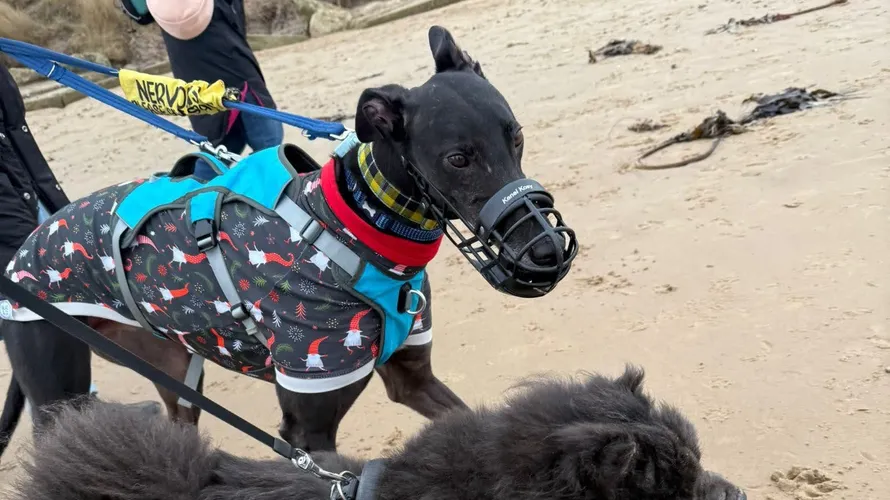
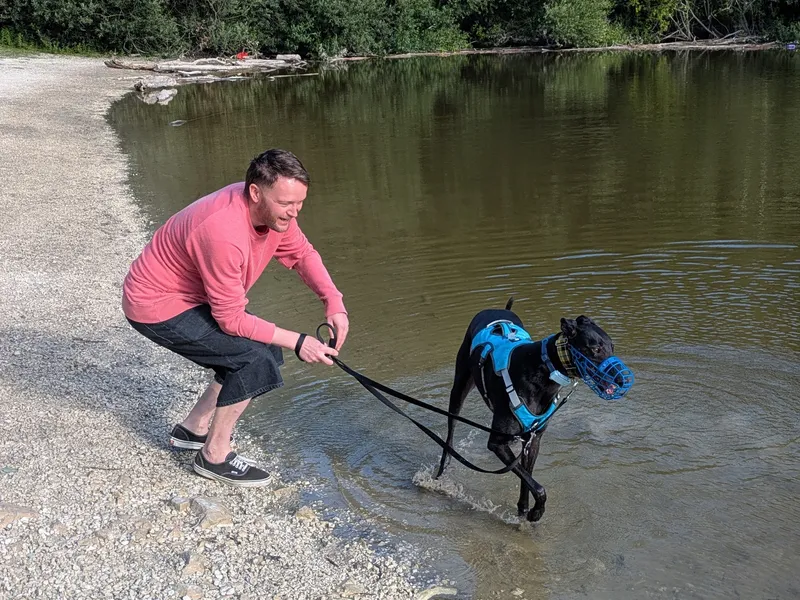
We chose to go for a ‘basket muzzle’ for our daily walks (specifically the 110 Lightweight Basket Muzzle from The Muzzle Shop). This allows us to give him treats whilst out and about really easily, with a bit of practice. A disadvantage of this muzzle is that drinking water is still difficult, which is the case with any muzzle. Thankfully, Winston will drink most after we get back in the car or after we’ve stopped at a picnic table, meaning we can quickly take the muzzle off and keep him hydrated.
Winston also looks dashing in his muzzle, if I do say so myself. If you’re a fashionista, you can even style them into outfits, like how we use a blue muzzle to match his harness. How cute.
How did our walking experience change after being consistent with muzzling
You actively reduce risk. Risk of biting, risk of eating things they shouldn’t and risk of altercations arising as a result of uninvited greetings.
Reduced bite risk & increased confidence
The most obvious benefit of a muzzle is that there is far less risk of your dog injuring another dog, animal or even another person when worn. This is not due to aggression or any behavioural issues. They simply have a high prey drive due to the fact that they’re genetically wired (and trained if from a racing background) to chase small furry things. In the early days it is really important for you to pay attention to this on walks, as prey sequencing can begin and progress quite quickly if you aren’t paying attention.
Using a muzzle also really works as a confidence boost for me as the owner, something I really needed at that time. I felt secure in knowing that there is no risk of his prey drive getting out of hand, and that confidence means that Winston also feels happier and more secure.
Reduced risk of foreign object ingestion
A secondary benefit, aside from protecting other dogs, is that it stops your greyhound from eating litter and whatever else they can get their snouts on. Around us there is all-sorts of stuff lying around, takeaway pizza boxes, dropped baby toys, and of course, poop.
Signal to others
There is also a third benefit. Having a muzzle gives signals to others that they should give you and your dog additional space, and should definitely ask before approaching you with a child or small dog. We previously used a ‘nervous sash’ to display these signals, but they were rarely considered when we were being approached by dogs on our walks. A muzzle is a signal which other owners seem to respect far more. Something that can’t be said for the aforementioned sashes.
Are muzzled dogs unhappy?
I want to dispel the notion that a muzzled dog is an unhappy dog. Winston has never shown any signs of frustration or unhappiness when wearing his muzzle, it is very common for them to be worn in their racing career and it isn’t nearly as debilitating as you might imagine. A muzzle is a tool for both of us to feel safer and more confident when walking in busy areas where unpredictable dogs and cats can emerge from anywhere.
So, should everyone muzzle their greyhound?
No, of course not. Every dog is different, but some can benefit greatly from adopting muzzles into your walking routine. I have seen cases of extremely reactive greyhounds where these muzzles are essential to the safety of passersby, though these are extremely rare and the usual greyhound temperament continues to be calm, curious and loving.
Only you can make the decision as to what is best for your greyhound and what is necessary to ensure your safety.
Bottom-line, muzzles aren’t as bad as I thought, they aren’t scary, they don’t mean that your dog is a monster, and you aren’t a bad owner for using one. There are myriad benefits to using one which I would not have known before using one regularly. If you need more confidence and security on your walks, I would recommend giving it a go.
Share :